BVN Stories — November 5, 2025
Workplace Futures: The Influence of Innovation
The ultimate challenge of design is to solve tomorrow's problems today. When we consider innovation in workplace design, we often focus on the tangible: new materials, smarter buildings and more efficient planning. But good design rarely results from a single influence. Usually, it is born from constraint. Striving to meet sustainability targets, budget pressures, or cultural shifts, the future of workplace design is responsive to multiple, evolving influences.
Culturally, the biggest workplace innovation of the past decade is not spatial. Microsoft Teams. Or Zoom. Or Slack. These digital platforms have completely reshaped how knowledge is shared, how hierarchies are flattened, and how collaboration occurs. They’ve made “location agnostic” the new normal.
So, what happens beyond the screen? As hybrid work matures, the challenge for design shifts from enabling connection to supporting creativity. The physical workplace must become a stage for the types of collaboration and serendipity that can’t happen digitally.
Workplaces are reflections of the societies they serve. They evolve as our values, technologies and relationships evolve. Real innovation can happen when we stop trying to control that change and instead design with it.
Esme Banks Marr, BVN Strategy Director
As we have in the past with new technologies, we greet the emergence of new techniques and workflows with eager and curious enthusiasm.The predictive intelligence of generative AI is helping us to innovate in ways that were thought to be impossible and tedious and each advancement continues to surprise.Yet, we remain conscious that AI needs to be treated as only one layer in our culture of innovation. It may help us work faster, but more importantly, it must be used in a way that enables us to work with amplified curiosity and an increased resolve to design workspaces that are better for the environment and a joy to inhabit.
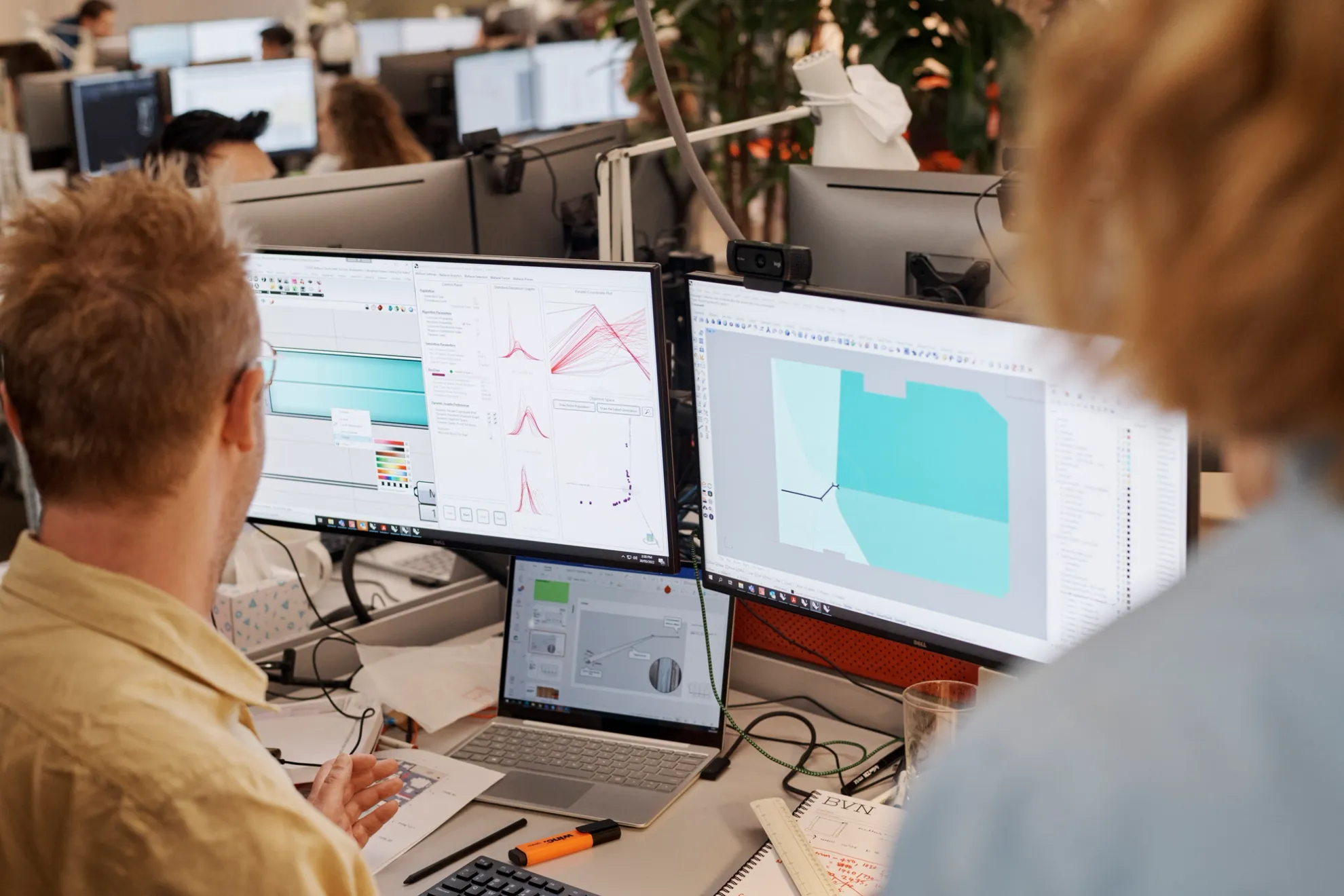
Computational tools that help generate, as well as evaluate, design possibilities can unlock time savings and also allow us to expand our frontiers of creativity. New aesthetics, design narratives, forms and programmatic arrangements can emerge when we consider new workflows, ways of drawing, modelling and communicating the workplaces we craft.
New imaginings can become physical realities. We strive to pair our design innovations with appropriately digitally enabled fabrication and procurement strategies so that not only do workplaces create new tools and experiences, but are also built in fundamentally new and better ways.
AI, for all its power, is still learning from what we've already done. It mines the past, not the possible. Instead of merely making us faster, it should help make us braver. When AI tools and digital systems become our active collaborators and start to help shape design from the ground up, we're not just optimising form - we're expanding the very language of architecture.
Matthew Blair, BVN Principal
In an era of carbon accountability, innovation and sustainability are inseparable. Designers can no longer default to “new equals better.” The climate crisis has made reuse and reconfiguration ultimate creative constraints.
Our recently launched De-fit Guide captures this perfectly as a manifesto for thinking beyond the lifecycle of a single fitout. De-fit, once a logistical headache, becomes an opportunity for innovation: designing for disassembly, for modularity, for what comes next.
Increasingly, clients’ sustainability targets present the opportunity for experimentation. A company’s need to meet its Environmental, Social, and Governance (ESG) commitments presents an opportunity to test new materials, pilot circular systems and shift behaviours across entire supply chains. The workplace, in this sense, is both a testbed and a catalyst for broader change.
De-fit, in its purest sense, unlocks the value of materials we already have. Turning waste into design opportunities, de-fit enables a new circular architecture to emerge. Through harvesting the materials we already have, the reuse process provides the best pathway for decarbonising our industry.
Adrian Taylor, BVN Regenerative Lead

The most powerful innovations are often invisible: a shift in mindset, a new way of working together, a design that quietly anticipates its next life. If innovation is the journey, not the destination, then we see our role as designers not to declare what’s next - but to stay curious enough to keep asking.